
Airbrush



Product sorting
Brands
System
List of products


Airbrush for Miniature Painting — Complete Equipment
An airbrush is the single most impactful upgrade a miniature painter can make — it allows you to prime models evenly, apply smooth base coats across an entire army in minutes, create seamless blends and gradients that are impossible with a brush, and achieve the zenithal highlight effects that make Contrast and Speedpaint colours sing. Once you've tried it, it's hard to imagine going back.
At Colours of Warriors, we stock a focused selection of airbrush equipment chosen for miniature painting — pistols from Harder & Steenbeck, compressors from Sparmax and Vallejo, and a full range of accessories, spare parts and cleaning supplies. Visit our store in Pilsen, Czech Republic, or order online with delivery across the EU.
What Can You Do with an Airbrush?
The most common uses of an airbrush in miniature painting are:
Priming — applying an even, controlled coat of primer across models. An airbrush gives significantly better coverage than spray cans in cold weather and allows you to prime indoors year-round without fumes.
Base coating large areas — covering vehicles, large monsters, terrain and entire infantry units with smooth, even colour in a fraction of the time a brush requires. A 10-man infantry unit that takes 20 minutes to base coat with a brush can be done in under 5 minutes with an airbrush.
Zenithal priming — applying black primer from below and white or grey primer from above to create a pre-shaded undercoat. This technique, combined with Contrast or Speedpaint colours, produces striking results in a single painting session.
Smooth blends and gradients — smooth transitions between colours on cloaks, armour panels and vehicles that are extremely difficult to achieve with a brush. OSL (Object Source Lighting) effects, glow effects and freehand gradients become accessible.
Weathering — chipping effects, modulation on vehicles, dust and grime applied with precise control. Combined with masking tape and stencils, an airbrush allows weathering effects that would take days with a brush to complete in an afternoon.
Airbrush Pistols — Harder & Steenbeck
We stock airbrush pistols from Harder & Steenbeck — a German manufacturer widely considered to produce the finest precision airbrushes available. Their pistols are the choice of professional figure painters and scale modellers worldwide, and their German engineering means they are built to last for years with proper maintenance.
The two main ranges in our stock:
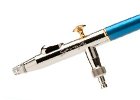
Harder & Steenbeck Infinity — the flagship double-action, gravity-feed airbrush. Available in 0.2mm and 0.4mm nozzle sizes, the Infinity is the most popular choice among advanced miniature painters for its exceptional precision and smooth trigger action. The 2-in-1 Kyiv Infinity variant includes both 0.2mm and 0.4mm nozzle sets, allowing you to switch between detail work and base coating with the same pistol.
The 0.2mm nozzle is ideal for fine detail work, line highlights and precise effects. The 0.4mm nozzle is the workhorse for base coating, priming and smooth blending — the most versatile size for general miniature painting.
Browse all airbrush pistols in our store.
Compressors — What You Need to Power an Airbrush
An airbrush requires a compressor to supply consistent air pressure. For miniature painting, a silent compressor with a tank is strongly recommended — it maintains consistent pressure, reduces the duty cycle of the motor and operates quietly enough to use in a home environment.
We stock compressors from two brands:
Sparmax — reliable and quiet compressors specifically designed for airbrush use. The Sparmax range offers excellent value for miniature painters, with tank-equipped models that maintain stable pressure across a full painting session.
Vallejo — Vallejo's compressor range is designed to pair with their airbrush paint lines and offers a compact, quiet option well-suited to hobby use at home.
When choosing a compressor, look for: a built-in moisture trap (prevents water droplets from entering the airbrush), a pressure regulator (allows you to set the working pressure precisely) and a tank of at least 1–2 litres for stable pressure.
Airbrush Paints — What to Use
Most acrylic miniature paints can be airbrushed when thinned correctly, but dedicated airbrush paints are pre-thinned to the ideal consistency and save significant time. The most popular airbrush paint ranges we stock:
Citadel Air — the Games Workshop airbrush range, pre-thinned to work directly through a 0.3–0.4mm nozzle. Available in the full Citadel colour range including metallics and technical effects.
Vallejo Game Air and Vallejo Model Air — Vallejo's dedicated airbrush ranges, pre-thinned and in dropper bottles for precise measurement. Game Air mirrors the Game Color palette; Model Air covers historical and realistic tones.
Standard acrylic paints (Citadel Base, Vallejo Game Color, Army Painter Fanatic) can also be airbrushed when thinned with airbrush thinner or flow improver to the consistency of semi-skimmed milk — thin enough to flow smoothly without clogging the nozzle.
Accessories — Cleaning and Maintenance
Proper cleaning and maintenance is the single most important factor in airbrush longevity. A well-maintained airbrush can last for years; a neglected one will fail within months. We stock a complete range of airbrush accessories:
Cleaning pot — the Green Stuff World Airbrush Cleaning Pot is our bestselling accessory. It provides a safe enclosed space to spray cleaning solution through the airbrush without contaminating your workspace, with a filter that catches paint particles. Essential for regular cleaning between colours.
Wash bottle — for rinsing the airbrush cup between colours during a painting session. Fill with water or airbrush cleaner and spray through to clear residual paint before loading the next colour.
Airbrush cleaner — dedicated cleaning solution that dissolves dried acrylic paint more effectively than water alone. Available from Vallejo and Green Stuff World.
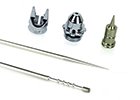
Spare parts — needles, nozzles, cups and seals for Harder & Steenbeck airbrushes. Available in our Spare Parts section. Having spare needles and nozzles is strongly recommended — these are the components most vulnerable to damage and bending.
Quick release connectors — allow you to disconnect the airbrush from the hose instantly without tools. Particularly useful when switching between multiple airbrushes or when moving the airbrush to the cleaning pot.
Stencils and templates — flexible airbrush stencils for repeating patterns on vehicles, terrain and bases. Available in our Templates section.
Respirator — the 3M Half Face Mask Respirator (4251) provides proper protection when airbrushing in an enclosed space. A basic dust mask is not sufficient — acrylic paint particles require an organic vapour respirator for safe use. Always ventilate your workspace when airbrushing.
Airbrush vs Spray Can — Do You Need Both?
Spray cans (aerosol primers from Citadel, Vallejo and others) are convenient, require no equipment and work well outdoors. Their limitations: they cannot be used indoors in cold weather, the pressure cannot be controlled, they are more expensive per ml of paint and they offer no control over spray pattern or direction.
An airbrush requires an upfront investment in equipment but offers complete control over pressure, paint flow, spray pattern and direction — and can be used indoors year-round. For painters who prime multiple models regularly or want to explore blending and zenithal techniques, an airbrush pays for itself within a year compared to spray can costs.
Many painters use both — spray cans for occasional priming outdoors, airbrush for everything else. Browse our spray primers and airbrush pistols in their respective sections.
Airbrush at Colours of Warriors
We're a specialist hobby shop based in Pilsen, Czech Republic, stocking Harder & Steenbeck airbrush pistols, Sparmax and Vallejo compressors, and a full range of accessories, spare parts and cleaning supplies. Our store at Zbrojnická 116/2 is open Monday to Friday 13:00–18:00. We ship across the Czech Republic and the EU.
Questions about which airbrush or compressor to choose? Contact us at obchod@coloursofwarriors.com or +420 737 281 727 — we're happy to advise based on your specific painting style and budget.
Frequently Asked Questions — Airbrush
What airbrush should I buy as a beginner?
For miniature painting beginners, a double-action, gravity-feed airbrush with a 0.4mm nozzle is the most versatile starting point. The 0.4mm nozzle handles base coating, priming and basic blending with minimal clogging and easy cleaning. Harder & Steenbeck produce the most reliable pistols in this category. Pair it with a quiet compressor with a tank — unstable air pressure is the most common cause of airbrush frustration for beginners.
What is the difference between 0.2mm and 0.4mm nozzles?
0.2mm produces a finer spray pattern for detail work, thin lines and precise effects — but requires more careful paint thinning and clogs more easily. 0.4mm is more forgiving, handles a wider range of paint viscosities and is ideal for base coating, priming and smooth blending. Most miniature painters start with 0.4mm and add 0.2mm later for advanced techniques. The Harder & Steenbeck 2-in-1 Kyiv Infinity includes both nozzle sizes.
Do I need a special compressor for an airbrush?
Yes — a dedicated airbrush compressor with a pressure regulator, moisture trap and ideally a tank provides stable, controlled air pressure. General workshop compressors are too powerful and lack the fine pressure control needed for miniature painting. We stock quiet, purpose-built compressors from Sparmax and Vallejo suitable for home use.
Can I use regular acrylic paints in an airbrush?
Yes — standard acrylic miniature paints (Citadel, Vallejo, Army Painter) can be airbrushed when thinned correctly with airbrush thinner or flow improver. The target consistency is similar to semi-skimmed milk. Dedicated airbrush ranges (Citadel Air, Vallejo Game Air) are pre-thinned and save time, but are not required.
How do I clean an airbrush?
After each painting session: empty the cup, add a small amount of water or airbrush cleaner, spray through the cleaning pot until the spray runs clear, then backflush by pressing the needle back while spraying to dislodge paint residue. For a full clean, disassemble the nozzle and needle and soak in airbrush cleaner. Clean your airbrush after every session — dried paint is the most common cause of blockages.
Is airbrushing suitable for beginners?
Yes, with the right expectations. Airbrushing has a learning curve — thinning paint correctly, controlling pressure and trigger action, and maintaining the equipment all take practice. Most painters feel comfortable with basic priming and base coating after 2–3 sessions. Advanced techniques like smooth blending take longer to master. The investment in time is well worth it for painters who work with multiple models or large armies.