
Fast-painting formulas have transformed the entire miniature painting hobby. Instead of the lengthy layering process of base coat → wash → highlight, a single layer over a light-colored base is enough — the paint itself creates shadows in the recesses and highlights on the raised details of the model. Two names dominate this category: Citadel Contrast from Games Workshop and Army Painter Speedpaint 2.0. Both essentially do the same thing — but they differ in details that might decide which one is right for you.
Here we'll compare how both paint lines work, where they differ from each other, how much they cost, and who each one suits. Without favoring either brand (both are a valid way to go) — just the practical differences you'll notice at the painting table.
How these paints work
Before we get into the comparison, it's worth understanding the principle behind fast miniature-painting techniques. Both lines are transparent paints applied in a single layer over a light-colored — white or grey — base coat. As the paint dries, it flows into the recesses, where it pools and creates a natural shadow, while it stays thin and light on the raised surfaces. The result is a model that could be described as roughly base-coated, while also gaining depth from shading in a single step.

This principle is identical for both Contrast and Speedpaint — which is exactly why they're so often compared directly. Speedpaints work in a very similar way to Citadel Contrast: you apply a single layer over a light base color, and the paint itself creates shadows in the recesses and highlights on the raised parts of the model.
A brief history
Citadel Contrast hit the market first, and essentially kicked off the entire trend of transparent fast-painting formulas (applying the base coat layer and the shading in a single step). It became the benchmark that every competing brand's paint line gets measured against.
Army Painter Speedpaint, however, ran into trouble right out of the gate. When the original Speedpaint launched in February 2022, it suffered from what's known as reactivation — applying another layer would suddenly "wake up" the paint underneath, which would bleed up into the new layer and mix together. You can probably imagine the mess that caused.
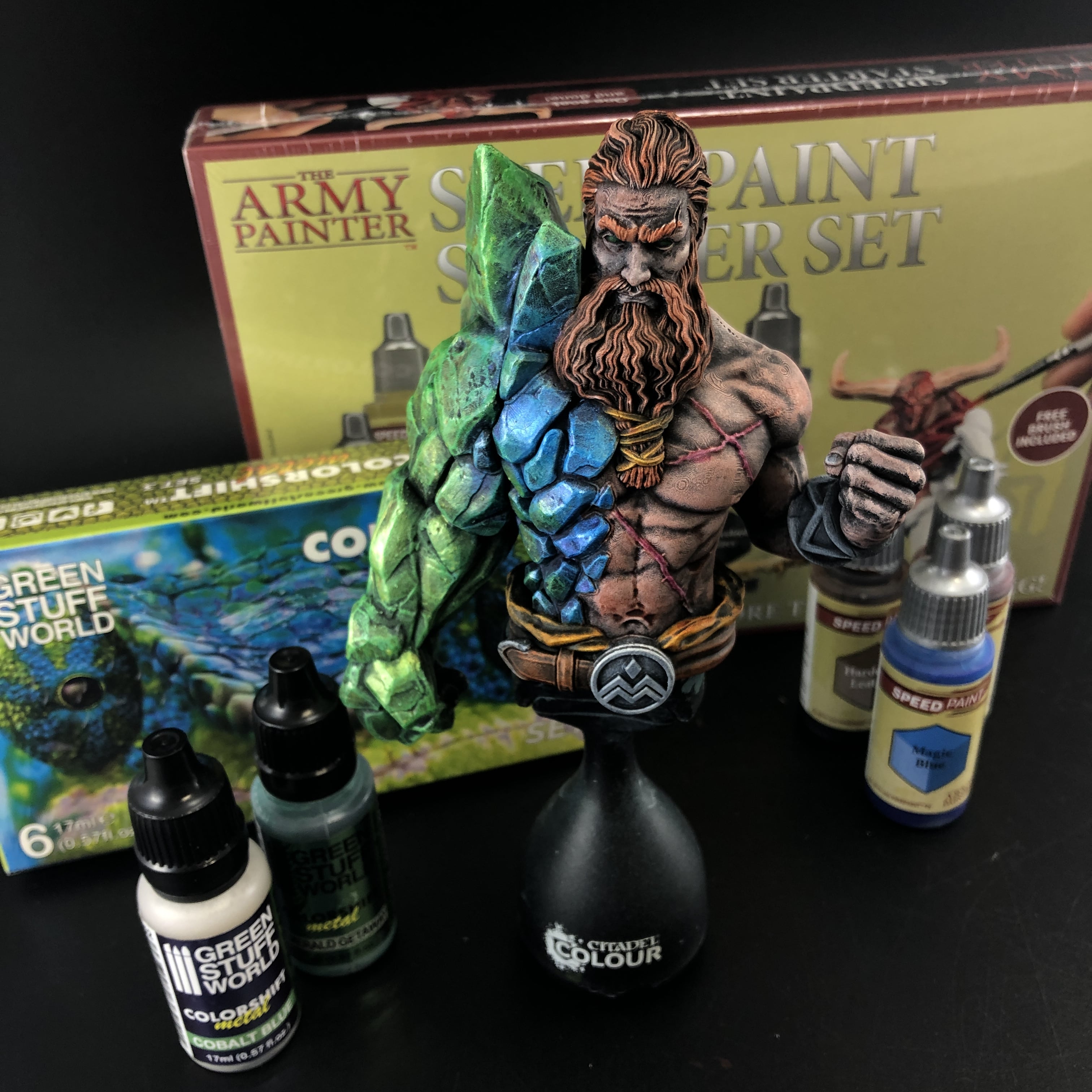
Army Painter went back to the drawing board and, in April 2023, released Speedpaint 2.0 with a reworked acrylic resin medium, designed specifically to fix that reactivation issue. The new formula becomes stable after roughly two hours of drying. That matters — when we talk about Speedpaint today, we're talking about version 2.0, which largely eliminated the original problem.
Citadel Contrast vs Speedpaint 2.0 — head to head
Citadel Contrast
- ✓ Doesn't reactivate once dry
- ✓ High pigmentation, rich color
- ✓ Matter finish
- ✓ GW guides name specific shades
- ✓ Excellent Contrast Medium
- ✗ More expensive per ml
- ✗ Pots, not droppers
- ✗ Works best on Citadel primers
- ✗ Smaller shade range than Speedpaint
The Army Painter Speedpaint 2.0
- ✓ Cheaper per ml
- ✓ Largest shade range — over 90 colors
- ✓ 18ml dropper bottles with agitator balls
- ✓ Works over any light-colored primer
- ✓ Metallic Speedpaints (unique)
- ✗ Very mild reactivation still exists (needs a proper full dry time)
- ✗ More satin (glossier) finish
- ✗ Holds up worse to mechanical wear, a protective varnish is a must
Five properties that decide it
Reactivation on repainting
Contrast doesn't reactivate once dry — you can layer over it without worry. Speedpaint 2.0 has significantly reduced reactivation, but it hasn't disappeared completely. Repainting with a very light color can cause a slight bleed-through from the layers underneath.
Advantage: ContrastShade range
With more than 90 shades, Speedpaint 2.0 is by far the largest line on the market — offering more options than any competitor, including unusual browns and darker skin tones. Contrast has roughly 60 shades.
Advantage: SpeedpaintPrice and packaging
Speedpaint 2.0 is significantly cheaper per milliliter, and comes in 18ml dropper bottles with mixing balls inside. Contrast comes in pots and costs more. The dropper format is also a more economical setup overall.
Advantage: SpeedpaintFinish (matte vs satin)
Contrast dries to a more matte finish, while Speedpaint 2.0 has a noticeably more satin sheen across the range — a side effect of the resin medium that gives it its stable drying time. In practice, a final matte varnish (which we'd recommend for both lines anyway) takes care of this.
Advantage: ContrastIntegration with Warhammer guides
Every official GW painting guide names specific Contrast shades. If you're painting Warhammer following the official tutorials, an instruction to "apply Iyanden Yellow" simply means buying a bottle of Iyanden Yellow. It's a straightforward way to follow along with tutorials, which suits a lot of painters.
Advantage: ContrastMetallic one-step paints
Army Painter was the first to pull off metallic paints in this format — the Speedpaint 2.0 line includes ten metallic shades. That's unique within this category of paints, and something Contrast doesn't offer.
Advantage: SpeedpaintComparison table
| Property | Citadel Contrast | Speedpaint 2.0 |
|---|---|---|
| Packaging | Pot | 18ml dropper + agitator balls |
| Number of shades | ~60 | 90+ (largest range) |
| Price per ml | Higher | Lower |
| Reactivation | None | Minimal (not zero) |
| Finish | More matte | More satin |
| Primer | Best with Citadel | Any light-colored one |
| Metallics | No | Yes (10 shades) |
| GW guides | Full integration | Limited |
How to use Speedpaint / Contrast paints — step by step
Light-colored primer
Spray on a white or grey primer. For a brighter, more saturated result, go with white; for more muted tones, go with grey. The zenithal highlight method is also popular — a black base with white sprayed from above. This gives the miniature a sense of depth right from the start.
Apply one generous layer
Load your brush with plenty of paint and apply it across the surface of the miniature. The paint should flow into the recesses on its own — don't keep working it for too long, let it settle. In short: fewer brush strokes, more time to dry.
Remove any excess (if it's pooling)
If paint is pooling on a flat area instead of in a recess, gently soak it up with a dry brush. This prevents uneven blotches on large surfaces like cloaks or armor.
Let it dry
With Speedpaint 2.0, we'd recommend letting it dry a bit longer than usual (ideally 2 hours) before applying another layer, to avoid reactivation. Contrast is much quicker on this front. After that, you can add details, highlights, or a second color.
Seal it with a varnish
Speedpaint 2.0 in particular holds up worse to handling — a final matte varnish is important, since it protects the paint and evens out the finish. We'd recommend varnish for both lines, but with Speedpaint it's practically mandatory.
So, which one should you pick?
🟠 Choose Citadel Contrast if...
You mainly paint Warhammer following official GW guides that name specific Contrast shades. You want a more matte finish without needing a varnish. You plan to layer individual colors and want zero reactivation. You prefer the highest pigmentation and richness.
🔵 Choose Speedpaint 2.0 if...
You want the lowest possible price and the widest shade selection. You paint models beyond Warhammer too (board games, D&D). You prefer dropper bottles. You want to try metallic paints in this format.
🎨 For complete Warhammer beginners
Contrast is usually the easier path — following the official guides is a great starting point when the paint named in the tutorial matches the bottle on the shelf. For a Warhammer newcomer, it's a gentle way to dive into the world of painting.
💡 For batch-painting large armies
Speedpaint 2.0 wins out for quickly painting a lot of models in one evening, thanks to its volume, price, and range. The dropper bottle is more economical, and the larger palette easily covers an entire army. Not that Contrast can't handle it too, but the dropper bottles are a nicer companion during longer painting sessions.
Summary — Contrast vs Speedpaint 2.0
- Both do the same job — fast-painting a miniature over a light base coat with built-in shading
- Citadel Contrast = higher pigmentation, more matte, doesn't reactivate, full integration with GW guides, pricier
- Speedpaint 2.0 = cheaper, largest range (90+), dropper bottles, metallic paints, slightly satin finish
- For Warhammer newcomers, Contrast is usually the easier path thanks to clear official guides
- For large armies and saving money, Speedpaint 2.0 comes out ahead
- Both need a light-colored primer — neither works over black
- You don't have to strictly pick one — they're compatible, and plenty of painters use both
Citadel Contrast, Army Painter Speedpaint 2.0, and Scale75 Instant — the full range of transparent paints is available at our shop in Plzeň at Zbrojnická 116/2, open Mon–Fri 1pm–6pm. We're happy to help with your choice and technique.
obchod@coloursofwarriors.com · +420 737 281 727